
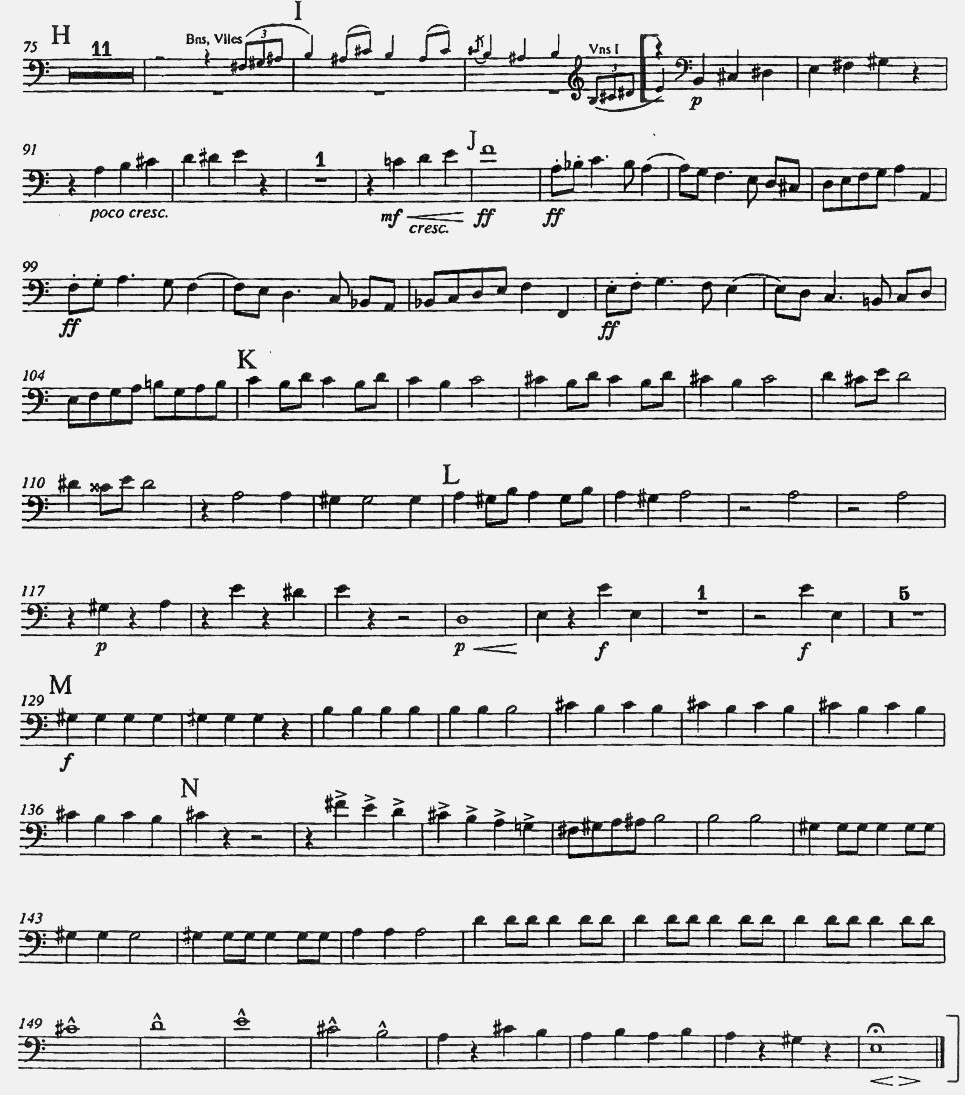
Symphony No. 1 - Brahms

Johannes Brahms (1833-1897), was a German composer of the Romantic era who used trombones sparingly but strategically.
Brahms completed Ein deutsches requiem (A German Requiem) by 1868. Brahms personalized the text rather than follow the traditional Requiem text. The writing for the trombones in this work is restrained, employed only when it really matters - solidly structural and not at all showy.
Johannes Brahms (1833-1897), was a German composer of the Romantic era who used trombones sparingly but strategically.
Academic Festival Overture (1880) is a celebratory collage of German student songs. Trombones are silent for much of this composition but when they do make an appearance late in the work, they add ceremonial authority.
Alexander Borodin (1833-1887) was a Russian composer of the Romantic period and a leading member of “The Five”. His orchestral writing leans towards dark, blended sonorities with trombones used as harmonic weight with chorale-like textures.
The symphonic poem “In the Steppes of Central Asia” (1880), depicts a caravan crossing the Asian plains. The trombones are used as part of a broader brass choir, adding breadth and structural balast.
Alexander Borodin (1833-1887) was a Russian composer of the Romantic period and a leading member of “The Five”. His orchestral writing leans towards dark, blended sonorities with trombones used as harmonic weight with chorale-like textures.
Alexander Borodin’s Polovtsian Dances was completed in 1876 for the opera Prince Igor. The troombones provide sustained resonance and weight. The ranges for the 2nd and 3rd trombones are unusually wide, with sustained B-flat pedal tones. The 1st trombone’s range is much narrower.
Hungarian March is one of the most frequent excerpts on orchestral audtions.
Hector Berlioz (1803-1869) was a French composer of the Romantic period.
Roman Carnival Overture (Le carnaval romain, H 95) is one of the composer’s most frequently performed overtures and includes extensive exposed passages for the trombone section.

Ludwig van Beethoven (1770-1827) was a German composer of the Classical and Romantic periods.
Beethoven Symphony No. 5 in C minor, Op. 67 is notable (particularly for trombone players) for being the first symphony to include trombones.

J.S. Bach (1685-1750) was a German composer of the Baroque era.
Bach’s Cantata No. 121 is a rare instance of his use of trombones. Trombones qre used sparingly, limited to the chorale at the end of the cantata. The alto trombone doubles violin II, the tenor trombone doubles the violas and the bass trombone doubles the continuo.